
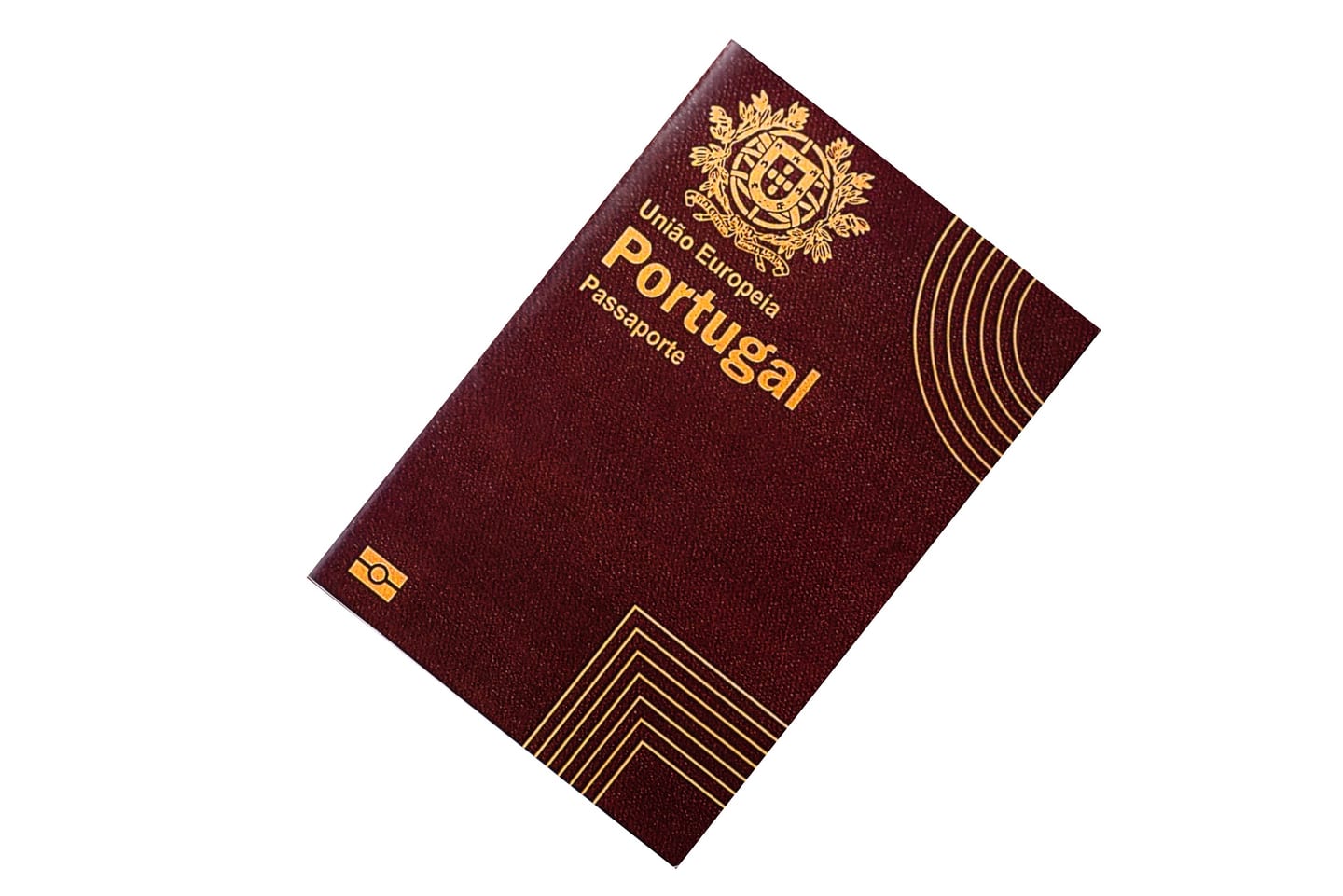
The three statuses, side by side
| Permanent residence permit | EU long-term resident status | Portuguese citizenship | |
|---|---|---|---|
| Legal basis | Foreigners Act, art. 80.º | Directive 2003/109/EC; Foreigners Act art. 125.º and following | Nationality Act, art. 6.º (as of 19.5.2026) |
| Years required | 5 years of temporary permits | 5 years of legal residence | 7 (EU and CPLP nationals) or 10 (others) |
| Language | basic Portuguese | basic Portuguese | A2 certificate + test on culture, history, symbols |
| Other conditions | no sentence over 1 year in the last 5 years; means; housing | stable resources, health cover | subsistence, clean record, solemn declaration, rights and duties |
| What it gives | no more renewals of the basis; card renewed every 5 years | right to move to another EU state under its rules | passport, vote, EU citizenship; dual nationality allowed |
| 2026 fee (AIMA / IRN) | 133 € + 351,10 € (263,40 € online) | analysis + card per AIMA table | 250 € |
Permanent residence (art. 80.º)
Granted to a foreigner who, cumulatively: has held a temporary residence permit for at least five years; has not been sentenced, in the last five years, to prison terms exceeding one year in total (with a wider bar for terrorism and organised crime); has means of subsistence (the 920 € scale); has accommodation; and proves basic knowledge of Portuguese.
The permanent permit has no expiry as a status; the card is renewed every five years (61,90 € in person, 46,30 € online). It ends only on the grounds of art. 85.º — including absence from Portugal for 24 consecutive months, or 30 non-consecutive months in three years, without valid reasons.
Why take it: no more proving the basis of your residence (the pension, the job, the business) at each renewal, and a stronger position for family reunification and credit.
EU long-term resident status
A parallel status under the EU directive, granted after five years of legal and uninterrupted residence to people with stable and regular resources and health cover. Its advantage is portability: a long-term resident may reside in another EU Member State for work, study or other purposes under that State’s rules, without starting from zero. It is worth requesting for anyone who may move within Europe; otherwise the national permanent permit is simpler.
Citizenship: the clock has moved
For applications lodged from 19 May 2026, naturalisation requires legal residence of seven years for citizens of EU Member States and of Portuguese-speaking countries, and ten years for everyone else (Nationality Act, art. 6.º n.º 1 b). The periods add up even if interrupted, provided they fall within a window of 9 years (EU/CPLP) or 12 years (others) — art. 15.º n.º 3. Applications pending on 19 May 2026 are decided under the old five-year rule (Lei Orgânica n.º 1/2026, art. 7.º n.º 2).
The other conditions are new too: proof by test or certificate of the language and of Portuguese culture, history and symbols; knowledge of rights, duties and the organisation of the State; a solemn declaration of adherence to the democratic rule of law; no effective prison sentence over three years for listed crimes; not being a threat to security; and the ability to support oneself. Details on citizenship by residence.
Time under a temporary-stay visa, a tourist stay or an expired permit does not count. Time under a residence permit — D7, D8, D2, D1, D3, D4, family reunification, CPLP, golden visa — does, as does time under the EU registration certificate for EU citizens.
Renewals before the five years
Temporary permits are issued for two years and renewed for three-year periods (art. 75.º); the renewal is requested before expiry through AIMA’s renewal portal (133 € analysis + 114,30 € card, 25 % less online), with proof that the basis continues — income for a D7, activity for a D2, contract for a D1 — plus tax and social-security compliance and no absences over six consecutive or eight cumulative months in the period (art. 85.º n.º 2).
Questions
I reached five years in June 2026. Can I still get citizenship in five?
Only if your application was pending on 19 May 2026. A file lodged after that date follows the new periods. You can apply for permanent residence now and for citizenship at seven or ten years.
Is "basic Portuguese" for permanent residence the same as A2?
The Foreigners Act asks for "conhecimento do português básico" without naming a level; AIMA accepts certificates from recognised courses and the CAPLE exams. The Nationality Act requires A2 for citizenship. An A2 certificate covers both.
Can I lose permanent residence?
Yes, on the grounds of art. 85.º: expulsion, fraud, serious crime, security, or prolonged absence (24 consecutive months, or 30 months in 3 years). Otherwise it does not lapse.
Sources and official references
- Lei n.º 23/2007 (Foreigners Act), consolidated — art. 80.º (permanent residence: 5 years, means, housing, basic Portuguese), 76.º, 85.º — checked 18.9.2026
- Lei Orgânica n.º 1/2026 — Nationality Act, art. 6.º (7 or 10 years), 15.º (counting periods), art. 7.º of the organic law (pending files) — checked 18.9.2026
- AIMA — fee table (Portaria n.º 307/2023): permanent permit 133 € + 351,10 € (263,40 € online), renewal 61,90 € — checked 18.9.2026
- Council Directive 2003/109/EC — status of third-country nationals who are long-term residents (5 years, stable resources, sickness insurance) — checked 18.9.2026