- 438 Blue Flag sites in 2026 (ABAAE), among them more than 340 coastal beaches, 45 inland river and lake beaches and 20 marinas — water quality, safety and services checked every season
- Albufeira leads with 24 flagged beaches, then Vila Nova de Gaia (19), Matosinhos (18), Viana do Castelo and Torres Vedras (11), Figueira da Foz, Odemira, Vila do Bispo, Loulé and Grândola (10 each)
- Two coasts, two seas: the Algarve's sheltered south coast with 29 °C summer highs and 1 mm of rain in July (Faro), and the Atlantic west with cooler water, bigger waves and, in Porto, 25 °C
- Season: lifeguards and flags from June to September on most beaches; the Blue Flag list is republished each spring
Portugal has about 940 km of mainland coast and two archipelagos, and the honest way to pick a beach is by the criteria that can be checked: the Blue Flag awards of the ABAAE (the Portuguese operator of the international programme), which certify water quality, safety, environmental management and services each year; the IPMA’s climate normals, which say how warm and how dry each coast is; and the region’s character — sheltered cove, surf beach, lagoon, river. Below, the 2026 list read region by region, with the beaches we send clients to when they ask.
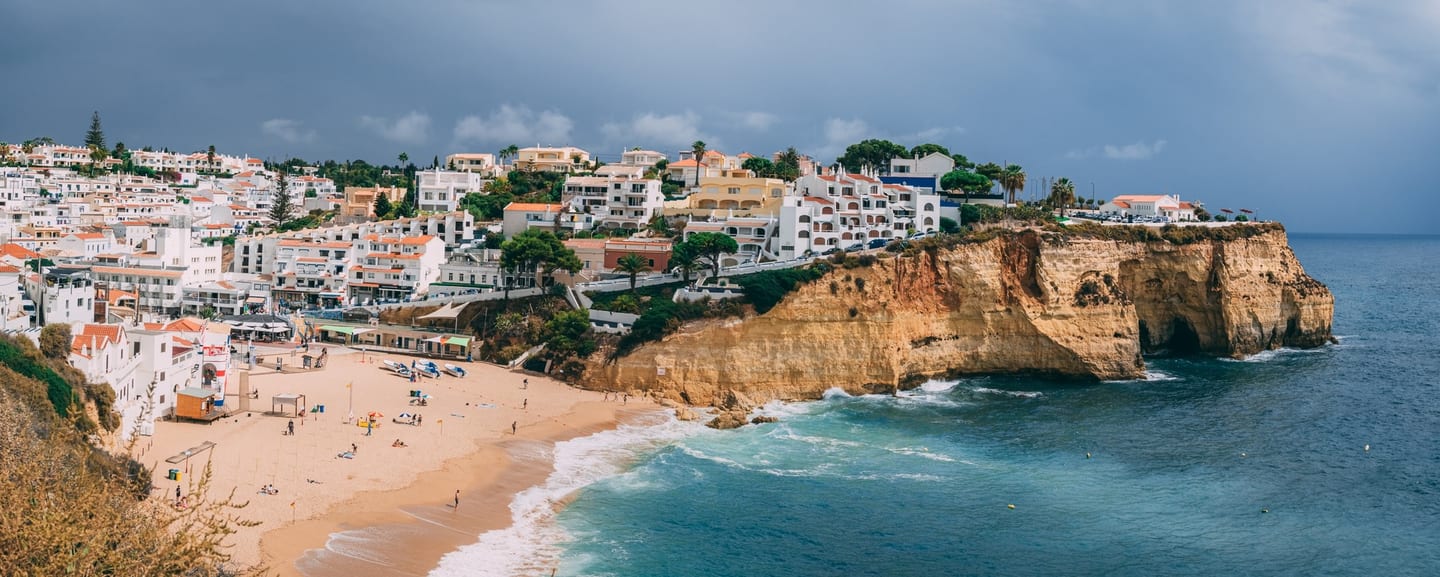
The Algarve: sheltered water, dry summers
The south coast is the only stretch of Portugal where the sea is calm enough for children most of the summer and the air reliably dry: Faro averages 29,4 °C in July with 0,9 mm of rain, 455 mm a year on 49 days (IPMA). The 2026 Blue Flags run the whole coast:
- Albufeira — 24 flagged beaches, the most of any municipality: Salgados, Santa Eulália, São Rafael, the three Rocha Baixinha beaches, Peneco, Olhos d’Água, Oura and the Falésia stretch.
- Loulé — Vilamoura, Vale de Lobo, Quarteira, Quinta do Lago, Garrão, Forte Novo, Ancão: long sand backed by the Ria Formosa.
- Lagos and Portimão — Porto de Mós, Meia Praia and Luz; Vau, Três Castelos, Rocha and the two Alvor beaches.
- Vila do Bispo — ten flags at the wild end of the coast: Zavial, Tonel, Salema, Mareta, Martinhal, Ingrina, Cordoama, Castelejo, Burgau — the last three on the west-facing side, with Atlantic swell.
- Tavira — the barrier-island beaches of Ilha de Tavira, Terra Estreita, Cabanas and Barril, reached by boat or the small train.
- Aljezur — Odeceixe, Monte Clérigo, Arrifana, Amoreira: the Costa Vicentina’s surf coves inside the natural park.
The Alentejo coast: space
Between the Algarve and the Sado, the Costa Vicentina and the Alentejo Litoral have the longest empty beaches in the country. Odemira flags ten in 2026 (Zambujeira do Mar, Malhão, Furnas, Almograve, Carvalhal, Farol) and Grândola ten (the Tróia beaches, Pego, Melides, Galé-Fontainhas, Comporta, Carvalhal, Atlântica). Water is Atlantic — cooler than the Algarve — and the wind is a feature; the reward is sand without a building behind it.
Lisbon’s coasts: the city’s beaches
Cascais — seven flags: Guincho Sul and Norte (surf and wind), Crismina, São Pedro do Estoril, Parede, Carcavelos (the city’s beach, on the train line), Avencas. Sintra — five: São Julião, Maçãs, Magoito, Grande (surf), Adraga, under cliffs. Almada — nine along the Caparica coast, reachable by bus and ferry from Lisbon. Sesimbra — Ouro, Moinho de Baixo-Meco, Lagoa de Albufeira and Califórnia, with the Arrábida coves beyond. Lisbon’s summer is 28,8 °C highs and 5 mm of rain in August (IPMA): the sea breeze does the cooling.
The Silver Coast and the centre: waves
Peniche — seven flags including Medão-Supertubos, Baleal Norte and Sul, Consolação; Nazaré — Salgado and Nazaré, the town beach below the giant-wave headland; Torres Vedras — eleven flags on a quiet coast an hour from Lisbon; Figueira da Foz — ten, with the widest sand in the country. Cooler water and bigger surf than the south; the seaside towns are Portuguese first and tourist second.
The north: town beaches and rain-washed sand
Vila Nova de Gaia (19 flags) and Matosinhos (18) line Porto’s metropolitan coast with beach after beach on the tram and metro — Meia Laranja, Angeiras, Memória, Pedras do Corgo; Póvoa de Varzim (8) and Viana do Castelo (11) continue north to the Minho. Porto’s summer is 24,8 °C in August with 29 mm of rain (IPMA): beach days are real, swims are brisk.
The islands and the rivers
Madeira’s flags are on Porto Santo’s nine-kilometre beach and on Madeira’s own bathing sites (Machico, Santa Cruz, Calheta, Porto Moniz’s natural pools); the Azores’ on the volcanic-sand beaches of Praia da Vitória (seven flags), Ponta Delgada, Ribeira Grande and Vila Franca do Campo. Inland, 45 river and lake beaches carry the flag in 2026 — the Zêzere and the schist-village rivers, the Alqueva lake at Mourão, Portel and Reguengos de Monsaraz, Castro Marim’s Odeleite dam — the summer alternative when the coast is full.
How to read a flag. The Blue Flag is awarded per season, on water-quality analyses, safety (lifeguards, equipment), environmental management and information. A beach that had it last year and not this year usually lost it on a technical criterion, not on the water; the ABAAE list is republished each spring at bandeiraazul.abaae.pt.
Which region has the warmest sea and driest summer?
The Algarve: Faro's normals give 29,4 °C July highs, 0,9 mm of July rain and 45 nights above 20 °C a year; the south coast is sheltered from the Atlantic swell.
How many Blue Flag beaches does Portugal have in 2026?
The ABAAE lists 438 awarded sites for 2026: more than 340 coastal beaches, 45 inland beaches, 20 marinas and a dozen eco-tourism boats.
Which town has the most flagged beaches?
Albufeira, with 24; then Vila Nova de Gaia (19) and Matosinhos (18).
Can I swim near Lisbon?
Yes: Carcavelos, Parede and the Estoril beaches are on the train line; Caparica's nine flagged beaches are across the bridge; Guincho and Sintra's beaches for surf.
When is the season?
Lifeguarded bathing seasons run roughly June to September (longer in the Algarve); outside the season, beaches are open but unsupervised.
Sources and official references
- ABAAE — Bandeira Azul: awarded sites 2026 (438 sites; list by region and municipality) — checked 19.9.2026
- ABAAE — Bandeira Azul programme: criteria (water quality, safety, environmental management, information) — checked 19.9.2026
- IPMA — Normais climatológicas 1991–2020 (Faro, Lisboa, Porto) — checked 19.9.2026