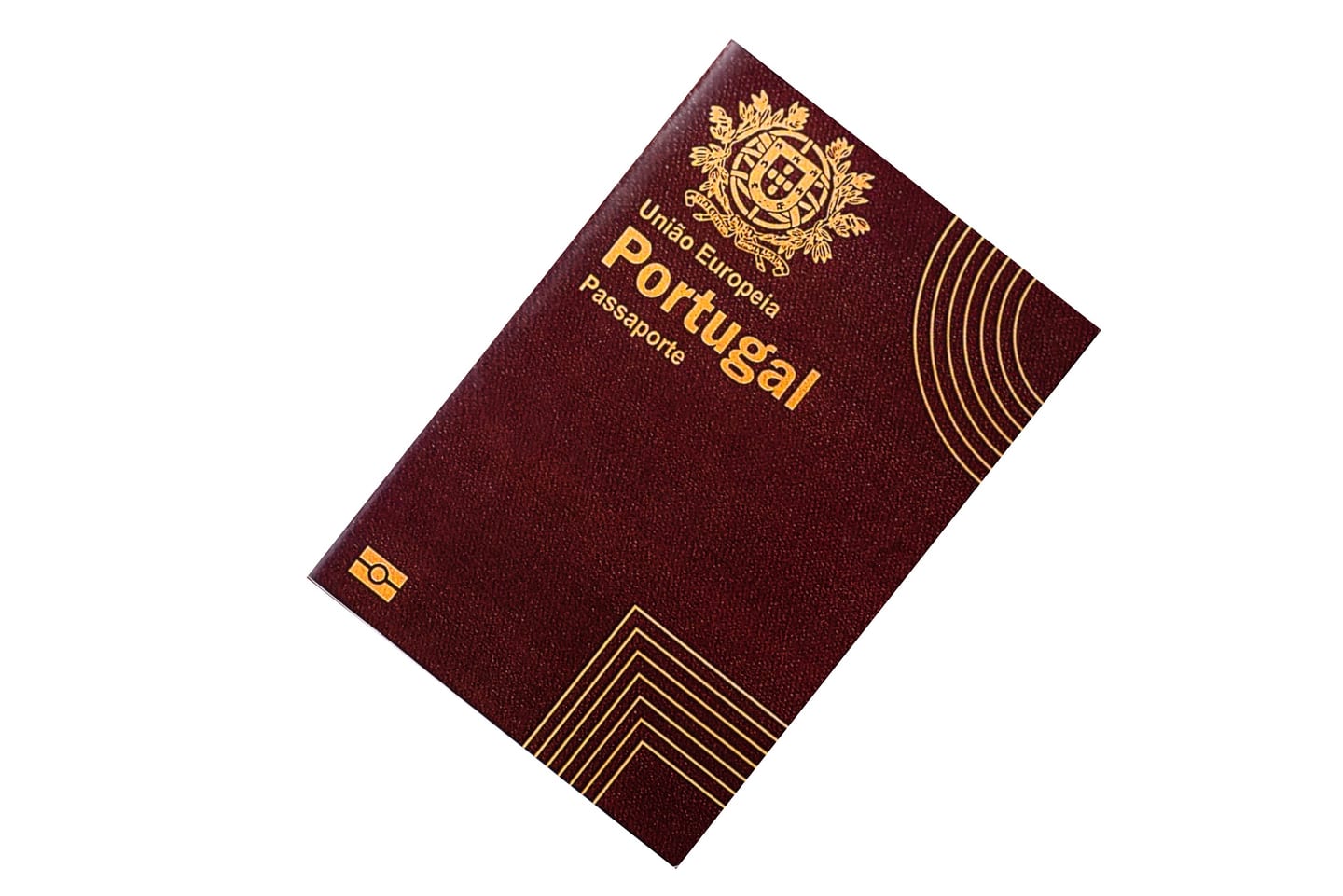
- Six levels, one scale: A1 to C2 of the Council of Europe's Common European Framework (CEFR); Portugal's official exams map onto it one to one
- The exam that matters for papers is A2: the CIPLE of the CAPLE (University of Lisbon), 95 €, pass mark 55 % — proof of Portuguese for nationality, the permanent residence permit and long-term resident status
- Free alternative: the State's PLA courses (Português Língua de Acolhimento) certify A1+A2 and B1+B2, and an A2 certificate from them is accepted for the same purposes
- Exams from 60 € (A1) to 170 € (C2), four components each, sittings in Portugal and at accredited centres abroad
Portuguese certification looks complicated from outside — CIPLE, DEPLE, DIPLE, PLA, QECR — and is in fact one ladder with two ways up it. The ladder is the CEFR, six levels from A1 (first words) to C2 (mastery). The two ways are the exams of the CAPLE, the University of Lisbon’s evaluation centre, and the free public PLA courses. Which one you need depends on what the certificate is for.
The six levels, in plain terms
| CEFR | What you can do | CAPLE exam | Fee |
|---|---|---|---|
| A1 | Very simple exchanges in a very limited number of everyday situations | ACESSO — Certificado de Acesso ao Português | 60 € |
| A2 | Basic interaction in predictable daily situations: shops, transport, forms, simple notes and news | CIPLE — Certificado Inicial | 95 € |
| B1 | Independent user: handle most situations, describe experiences, give reasons | DEPLE — Diploma Elementar | 115 € |
| B2 | Fluent, spontaneous interaction; detailed text on a range of subjects | DIPLE — Diploma Intermédio | 135 € |
| C1 | Flexible, effective use for social, academic and professional purposes | DAPLE — Diploma Avançado | 155 € |
| C2 | Near-native precision and nuance | DUPLE — Diploma Universitário | 170 € |
Every CAPLE exam has four components — reading and writing, listening, speaking, plus structural competence from B1 — and the same scale: 55 % to pass (Suficiente), Bom from 70 %, Muito Bom from 85 %. The CIPLE takes about two hours; the DUPLE nearly five. Candidates must be 16 or over; school versions (CIPLE-e, DEPLE-e, DIPLE-e) exist for 12–15-year-olds.
Which level for which purpose
Nationality. The Nationality Act requires “sufficient knowledge of the Portuguese language”; the Nationality Regulation has long accepted the CIPLE (A2) or a certificate from a recognised Portuguese course as proof. Nationals of Portuguese-speaking countries are presumed to know the language. Since Lei Orgânica n.º 1/2026 the naturalisation file also includes a test on Portuguese culture and institutions, separate from the language proof — see nationality by residence and nationality by marriage.
Permanent residence permit and long-term resident status. Article 80.º of the Foreigners Act asks for “basic knowledge of Portuguese” for the permanent permit after five years; AIMA states that an A2 certificate, including one issued by a PLA course, proves it for the permanent permit, for EU long-term resident status and for nationality.
Work and study. No law fixes a level for employment; employers and professional bodies do. Universities set their own admission level for programmes taught in Portuguese, often B1 or B2 — ask the faculty which certificate it accepts. Doctors, nurses and other regulated professions are tested by their Ordem.
Nothing at all. Visas — D7, D8, D2, D1, family reunification — and the temporary residence permit require no Portuguese. The language enters the file at the permanent permit and at nationality, years later. That is the window to learn it.
Two ways to the certificate
The CAPLE exam
Register on caple.letras.ulisboa.pt for a sitting at a LAPE — an accredited exam centre in Portugal or abroad; the CIPLE runs in the international sessions of May, July and November and in additional national sessions (CIPLE-P). Results are consulted online; the certificate is issued by the University of Lisbon. Anyone 16 or over may sit, whatever way they learned the language.
The PLA course
Português Língua de Acolhimento courses (Portaria n.º 183/2020, amended in 2022) are run by public schools through DGEstE, by IEFP training centres and by Qualifica centres, for residents aged 16 or over whose mother tongue is not Portuguese. You qualify with a residence title, or with proof that a residence application or renewal is pending, an international-protection request, or a Social Security number (NISS). The courses certify A1+A2 and B1+B2, and "certification at level A2 or above proves knowledge of Portuguese for the permanent residence permit, long-term resident status and Portuguese nationality" (AIMA). They are free; the cost is the timetable.
Which to choose. If you need the certificate on a date — a nationality file to lodge, a permanent permit due — sit the CIPLE: it is scheduled, the result is quick and it is recognised everywhere. If you have time and want the language rather than the paper, the PLA course gives both, at no cost, and its A2 certificate serves the same file.
Preparing for the CIPLE
The A2 syllabus is practical: signs and timetables, simple forms, short messages, a menu, instructions on a medicine box, basic news items; speaking in pairs about everyday topics. The CAPLE publishes the descriptors and sample tasks for each exam. Three habits that get candidates through: read the Portuguese version of every letter Finanças, Social Security and AIMA send you; do your errands in Portuguese even when the other person switches to English; and sit a mock exam under time, because the two-hour format, not the vocabulary, is what surprises people.
Is the CIPLE enough for Portuguese nationality?
Yes: the CIPLE (A2) is the certificate the Nationality Regulation accepts as proof of knowledge of the language, alongside certificates from recognised courses such as the PLA. The 2026 law added a culture and institutions test, which is separate.
How much does the exam cost?
60 € (ACESSO, A1), 95 € (CIPLE, A2), 115 € (DEPLE, B1), 135 € (DIPLE, B2), 155 € (DAPLE, C1), 170 € (DUPLE, C2) — the CAPLE's 2026 fees.
Can I sit the exam outside Portugal?
Yes, at the CAPLE's accredited centres (LAPE) abroad, in the international sessions. Check the calendar and the centre nearest you on the CAPLE site.
Do Brazilians need a certificate?
Nationals of Portuguese-speaking countries are presumed to know the language for nationality purposes and file no certificate.
Are the PLA courses really free?
Yes — they are public courses under Portaria n.º 183/2020, offered by schools, IEFP and Qualifica centres to residents aged 16 or over; places depend on local demand.
Sources and official references
- CAPLE (Universidade de Lisboa) — CIPLE: level A2, four components, ≈ 2 hours, fee 95 €, scale 55–100 %, sittings May/July/November + CIPLE-P — checked 19.9.2026
- CAPLE — exams list and registration rules (16 or over; school versions 12–15) — checked 19.9.2026
- CAPLE — ACESSO (A1, 60 €), DEPLE (B1, 115 €), DIPLE (B2, 135 €), DAPLE (C1, 155 €), DUPLE (C2, 170 €) — checked 19.9.2026
- AIMA — Cursos de Português Língua de Acolhimento (PLA): Portaria n.º 183/2020, eligibility, A1+A2 and B1+B2, A2 accepted for permanent residence, long-term residence and nationality — checked 19.9.2026
- Lei Orgânica n.º 1/2026 — Nationality Act: knowledge of Portuguese and the culture test among the naturalisation conditions (art. 6.º) — checked 19.9.2026
- Lei n.º 23/2007, art. 80.º — permanent residence permit: basic knowledge of Portuguese — checked 19.9.2026