- Twelve Historic Villages (Aldeias Históricas de Portugal), all in the Beira Interior along the Spanish border: Almeida, Belmonte, Castelo Mendo, Castelo Novo, Castelo Rodrigo, Idanha-a-Velha, Linhares da Beira, Marialva, Monsanto, Piódão, Sortelha, Trancoso
- Twenty-seven Schist Villages (Aldeias do Xisto) in the Lousã, Açor, Zêzere and Tejo-Ocreza hills of the centre, from Talasnal and Candal to Janeiro de Cima and Água Formosa
- UNESCO's three village-scale sites: the historic centres of Guimarães and Évora, and the Cultural Landscape of Sintra — among Portugal's 17 World Heritage properties
- The interior is the cheapest Portugal: INE's median prices fall far below the national 2 337 €/m² there, and the IPMA normals promise four seasons — 53 frost days a year in Bragança, 88 days above 30 °C in Beja
Portugal’s most beautiful villages are not a matter of taste alone: two public networks have selected and restored them, and UNESCO has listed three towns whose old centres still work as villages. This guide follows those lists — the twelve Historic Villages, the twenty-seven Schist Villages, the World Heritage centres — and adds what a newcomer needs to know before falling in love with granite and silence: what the interior costs, what its winters are like, and how far the nearest hospital is.
The Historic Villages of Portugal
The Aldeias Históricas de Portugal are a network of twelve fortified villages in the Beira Interior, restored since the 1990s with public investment and run as a single destination with an events calendar, walking and cycling routes and a co-working programme. Each has a castle, a wall or a medieval charter, and a population that was leaving until the restoration began.
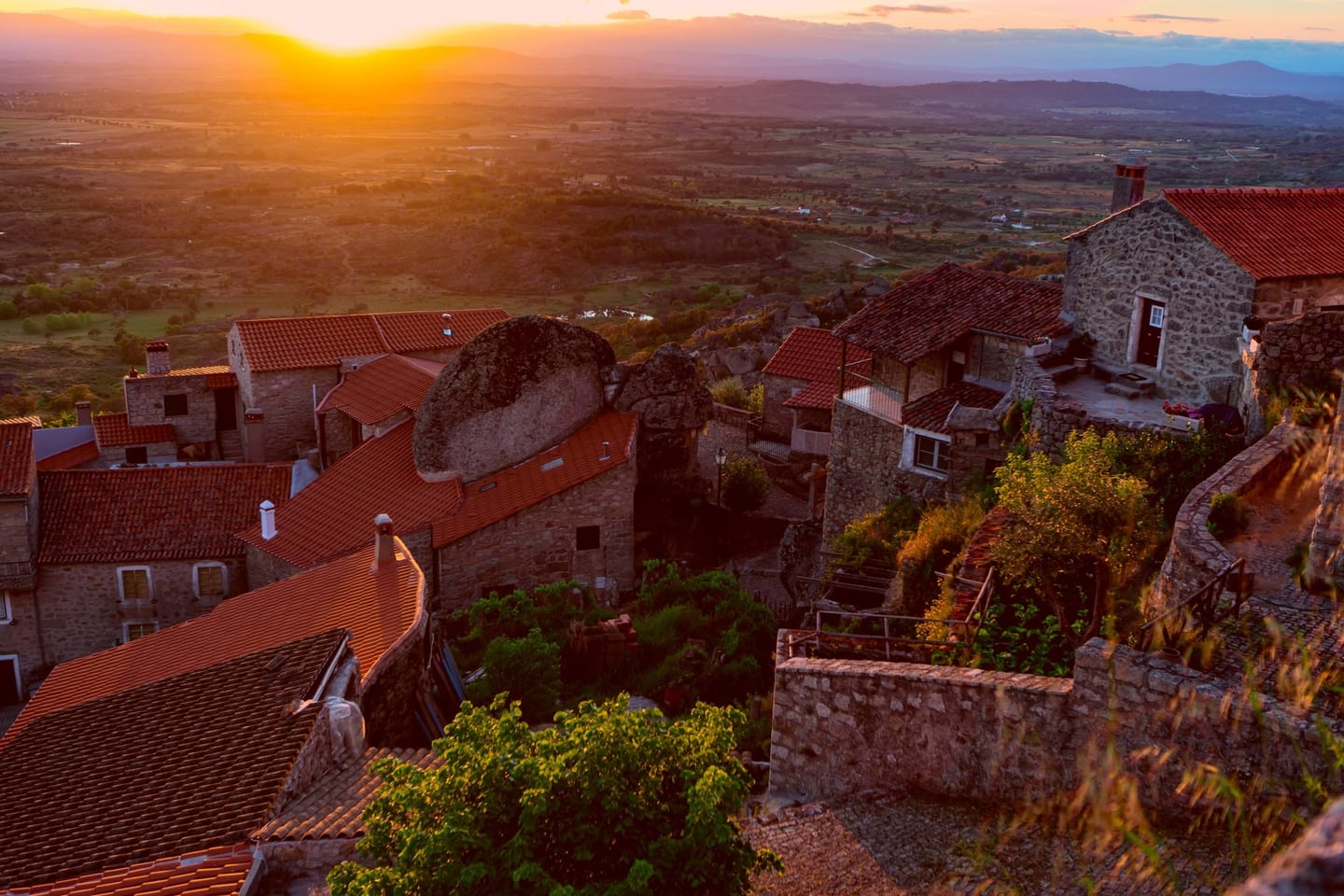
- Monsanto — houses built between, under and on top of granite boulders, a castle on the crest; the classic image of the network.
- Sortelha — a complete ring of walls on a hilltop, one street, granite houses.
- Idanha-a-Velha — a Roman and Visigothic town inside later walls, with a cathedral, an olive press and the Ponsul river.
- Piódão — schist and slate houses stepped up a hillside of the Serra do Açor, painted blue at the doors; the most remote of the twelve.
- Belmonte — birthplace of Pedro Álvares Cabral and home of a Jewish community that kept its faith in secret for centuries; castle, synagogue, museums.
- Almeida — a star-shaped 17th-century fortress town, walls intact, on the border.
- Castelo Rodrigo, Castelo Mendo, Castelo Novo, Linhares da Beira, Marialva, Trancoso — castles, Jewish quarters, Manueline pillories and views over the Côa and the Serra da Estrela.
Practical: the twelve lie between Guarda, Castelo Branco and the border, two to three hours from Lisbon or Porto by car; Guarda (1 019 m) is the coldest city in the country, with 32 frost days a year (IPMA), and the villages sit at similar altitudes.
The Schist Villages
The Aldeias do Xisto network groups twenty-seven villages in the schist hills of the centre — the Serra da Lousã (Aigra Nova, Aigra Velha, Candal, Casal de São Simão, Casal Novo, Cerdeira, Chiqueiro, Comareira, Coentral Grande, Ferraria de São João, Gondramaz, Pena, Talasnal), the Serra do Açor (Benfeita, Aldeia das Dez, Fajão, Sobral de São Miguel, Vila Cova de Alva), the Zêzere valley (Barroca, Álvaro, Janeiro de Baixo, Janeiro de Cima, Mosteiro, Pedrógão Pequeno) and the Tejo-Ocreza (Água Formosa, Figueira, Martim Branco, Sarzedas). The network runs river beaches, the Grande Rota do Zêzere walking trail, cycling routes, craft and design workshops and a “live and invest” programme for people who want to move there. Coimbra, an hour away, is the reference city: 16,2 °C annual mean, 866 mm of rain, six frost days (IPMA).
Villages inside World Heritage
Three of Portugal’s 17 UNESCO World Heritage properties are places to live at village scale:
- Historic Centre of Évora (1986) — Roman temple, cathedral, whitewashed streets inside the walls; the Alentejo’s capital, with the hot summers of the interior (33,3 °C July highs, 87 days a year above 30 °C).
- Historic Centre of Guimarães and Couros Zone (2001, 2023) — the “birthplace of Portugal”, castle and medieval core, an hour from Porto; median house price 2 108 €/m² in early 2026, well under the national figure (INE).
- Cultural Landscape of Sintra (1995) — palaces, gardens and mist on the hills west of Lisbon; village in look, capital-region prices.
Óbidos, Marvão, Monsaraz and the Douro wine villages (the Alto Douro Wine Region is itself a World Heritage landscape since 2001) belong on any list of the beautiful, without a formal network behind them.
Living in a village: the questions the postcards skip
Price. The interior is where INE’s medians fall to a third of Lisbon’s; the Coimbra region stands at about 1 500 €/m² and rents below 8 €/m² in Leiria and 6,50 €/m² in Guimarães — see where to live in Portugal.
Weather. The Beira villages have real winters (Guarda: 7 °C January highs, snow on the Estrela) and the Alentejo real summers; the climate guide gives each station’s figures.
Services. Health centres exist in every municipality; hospitals are in the district capitals — Guarda, Castelo Branco, Coimbra, Évora — often an hour away. Schools consolidate in the towns; internet is generally good (the Historic Villages publish their coverage). A car is not optional.
Buying an old house. Ruins in a Historic Village are subject to the same municipal licensing as anywhere and often to heritage protection zones, which move works into the licence regime with external opinions — read building permits in Portugal before buying, and ask the câmara for a pedido de informação prévia.
Language. Daily life runs in Portuguese; the villages are the opposite of the Algarve in that respect — see living in Portugal without speaking Portuguese.
Which are the Historic Villages of Portugal?
Almeida, Belmonte, Castelo Mendo, Castelo Novo, Castelo Rodrigo, Idanha-a-Velha, Linhares da Beira, Marialva, Monsanto, Piódão, Sortelha and Trancoso — twelve villages of the Beira Interior in one public network.
What are the Schist Villages?
A network of 27 villages in the schist hills of central Portugal (Lousã, Açor, Zêzere, Tejo-Ocreza), restored and run together with river beaches, trails and crafts programmes.
Can foreigners buy and restore village houses?
Yes, with a NIF; works follow the municipal licensing rules and, in protected zones, the heritage regime. A prior information request to the council settles what may be done before you buy.
Are these villages cheap to live in?
Housing is far below the national median; the trade-off is distance to hospitals, schools and airports, and a car-dependent life.
Sources and official references
- Aldeias Históricas de Portugal — the twelve villages and the network's programmes — checked 19.9.2026
- Aldeias do Xisto — the 27 villages by territory (Serra da Lousã, Serra do Açor, Zêzere, Tejo-Ocreza) — checked 19.9.2026
- UNESCO World Heritage Centre — Portugal: 17 properties (Évora 1986, Sintra 1995, Guimarães 2001/2023, Alto Douro 2001…) — checked 19.9.2026
- IPMA — Normais climatológicas 1991–2020 (Guarda, Bragança, Coimbra, Évora, Beja) — checked 19.9.2026
- INE — Estatísticas de Preços da Habitação ao nível local, 1st quarter 2026 (Guimarães 2 108 €/m²; Região de Coimbra 1 491 €/m²) — checked 19.9.2026
- INE — Estatísticas de Rendas da Habitação ao nível local, 1st quarter 2026 (Leiria 7,94 €/m², Guimarães 6,50 €/m²) — checked 19.9.2026