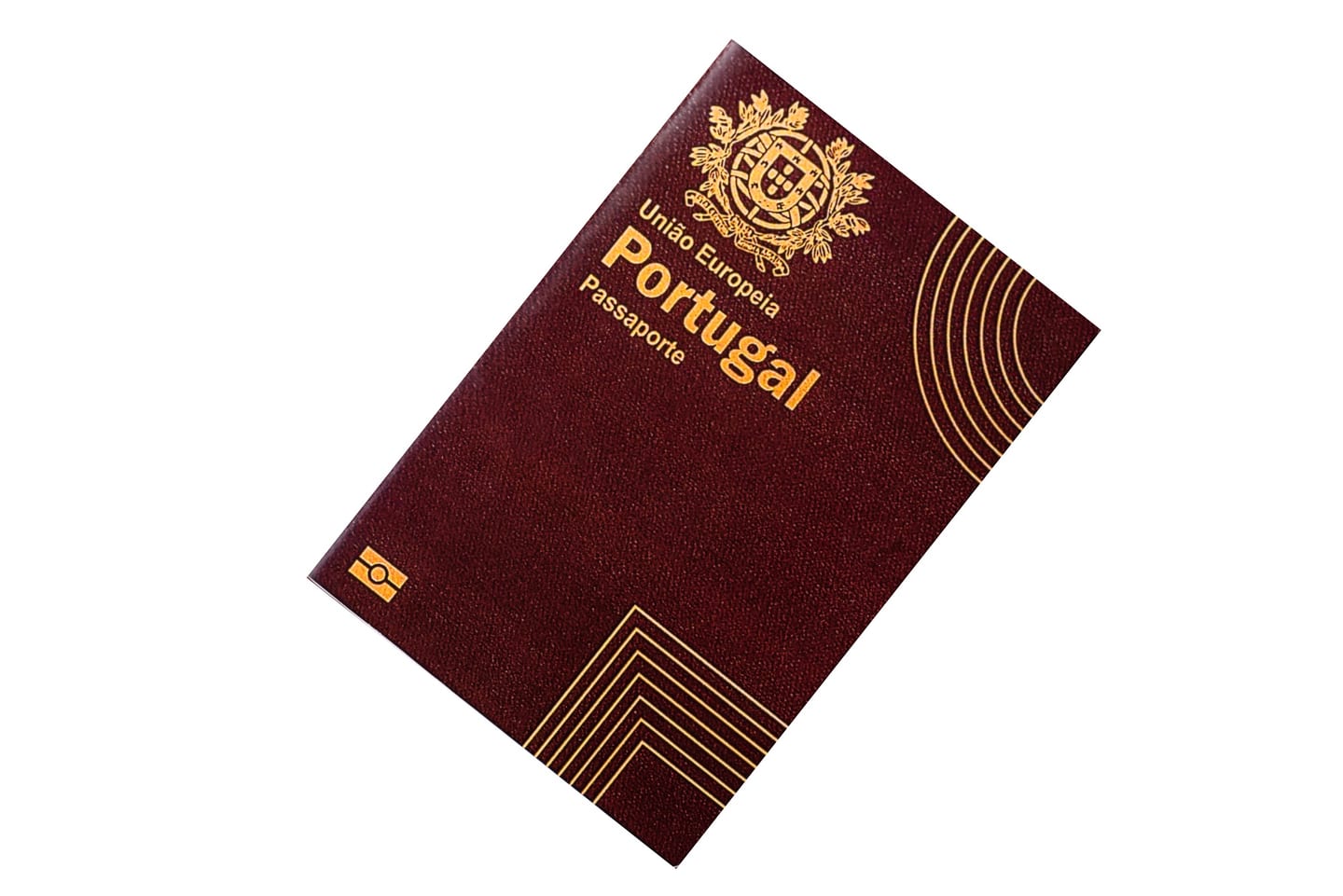
- The route is the D7 visa: proof of regular passive income of at least the minimum wage — 920 € a month in 2026 — plus 50 % per adult and 30 % per child, then a residence permit renewed for two years, then three, and a permanent permit after five
- The tax regime for retirees is the ordinary one: the NHR closed on 1 January 2024 and its successor, the IFICI, covers only listed professional activities, not pensions; foreign pensions are taxed in Portugal after a 4 587 € deduction, at 12,5 % to 48 %, with treaty rules deciding which country taxes what
- Prices 15 % below the EU average (Eurostat 2024), the health service open to permit holders, S1 cover for EU and UK pensioners, no inheritance tax between spouses and descendants
- Nationality after 7 years of legal residence for EU and CPLP nationals, 10 for others, with A2 Portuguese and a culture test (Lei Orgânica n.º 1/2026)
Portugal earned its reputation as a retirement country in the years of the non-habitual resident regime, when a foreign pension could be received tax-free or at 10 %. That regime is closed. What remains is a country whose visa for retirees is one of the simplest in Europe, whose price level is a sixth below the EU average, whose climate the IPMA measures at 17,6 °C in Lisbon and 18,2 °C in Faro, and whose tax on pensions is now ordinary — which is the first thing to plan around. This is the 2026 picture, from an office that files retirement cases every week, with the official figures behind each point.
The visa: D7
The D7 residence visa is for people who live on income they already have: pensions, rents, dividends, interest, royalties. The consulate asks for proof of regular income of at least the Portuguese minimum wage for the applicant — 920 € a month in 2026 — plus 50 % for a spouse and 30 % per dependent child, twelve months of it in a Portuguese bank account or documented from the source; accommodation in Portugal (a lease or a deed); a criminal record certificate; travel insurance with repatriation; and a NIF. The fee is 110 €, the decision takes up to 60 days, and the visa allows two entries over four months to reach the AIMA appointment where the residence permit is issued: two years, then three-year renewals, then the permanent permit after five years. The D7 visa guide has the full document list; renewing a residence permit explains the online renewal.
EU and EEA citizens need no visa: they register their residence with the câmara municipal after three months and follow the same path to the permanent card.
Tax: the ordinary regime, with the treaty on top
Three facts replace what most retirees have read:
- The NHR is closed to new residents since 1 January 2024 (Lei n.º 82/2023). Its successor, the IFICI (EBF art. 58.º-A), taxes employment and self-employment income from listed scientific, technical and innovative activities at 20 % for ten years — it has nothing for pensions.
- Foreign pensions are taxed as pensions under the Código do IRS: the first 4 587 € (8,54 × IAS) is deducted (art. 53.º), the rest joins the household’s income and is taxed at the 2026 brackets from 12,5 % to 48 % (art. 68.º), with joint filing for couples. Annuities and capital-based pensions have a capital component taxed differently (art. 54.º).
- The treaty decides which country taxes. Under most of Portugal’s conventions, private pensions are taxable only in the State of residence — Portugal — while government-service pensions stay taxable in the paying State; the UK–Portugal convention in force from 1 January 2026 follows that model (art. 17 and 18), and the US, Canadian, German and other treaties each have their own rules. Our country tax guides set them out, with the Portuguese credit for tax paid abroad (art. 81.º).
A retiree with a 30 000 € private pension and no other income, filing alone, therefore pays Portuguese tax on 25 413 € under the brackets — a real bill, but a predictable one, and often lower than at home once local rates and social charges are compared.
Health
With the residence permit you register at the health centre and receive the SNS user number; the public system then covers you, with user fees only for unreferred hospital emergencies since 2022. EU pensioners register the S1 form from their home institution and are covered by the SNS at the home system’s expense; UK State pensioners keep the S1 under the Withdrawal Agreement. Others rely on the SNS after the permit and, before it, on the travel insurance the visa requires. Private plans buy speed and choice but most stop accepting new customers around 65–70 — the reason to buy before moving, if you want one. See health insurance requirements and the health insurance guide.
Cost, climate and where retirees settle
Eurostat’s 2024 price level puts Portugal at 85 with the EU at 100 — restaurants and hotels at 75,5, housing at 80,1, but food at 101,5 and telecoms at 115,6. Housing is the exception the average hides: median sale prices of 5 292 €/m² in Lisbon and 3 352 €/m² in the Algarve against 2 337 €/m² nationally (INE, Q1 2026). The Algarve (Faro: 18,2 °C annual mean, 455 mm of rain, 45 nights above 20 °C), the Lisbon coast (17,6 °C, no frost) and Madeira (20 °C) draw most retirees for the climate; the Silver Coast, the Alentejo coast and the centre draw those who prefer the prices. The cost of living comparison, the climate guide and where to live give the figures region by region.
Estate planning
Portugal has no inheritance tax; transfers on death carry stamp duty of 10 % on assets in Portugal, from which the spouse, descendants and ascendants are exempt. Portuguese forced-heirship rules apply by default to residents, but a foreign national may choose the law of their nationality in a will under EU Regulation 650/2012 — the single clause every retiring couple should have. See inheritance law for expats.
The long game: permanent residence and nationality
After five years of temporary permits the permanent permit requires means, accommodation, a clean record and basic Portuguese (A2). Nationality by naturalisation, since 19 May 2026, requires seven years of legal residence for EU and CPLP nationals and ten for others, the A2 certificate, a test on Portuguese culture and institutions, and the other conditions of art. 6.º of the Nationality Act — see nationality by residence. The free public Portuguese courses (PLA) are the sensible way to get the A2 in the first two years, while exams are easy.
The order we recommend. Tax simulation first, with the treaty of your country and your actual pension mix — before the property, before the visa. Then health cover, bought before 65. Then the D7 file, six months before the intended move. Then the will with the choice of law. The couples who do it in that order have no surprises; the ones who buy the house first sometimes do.
Is there still a tax break for retirees in Portugal?
No. The NHR closed on 1 January 2024; the IFICI that replaced it covers listed professional activities, not pensions. Pensions are taxed under the ordinary brackets after the 4 587 € deduction, with the treaty deciding which country taxes each pension.
How much income do I need for the D7?
At least the minimum wage — 920 € a month in 2026 — for the applicant, plus 50 % per additional adult and 30 % per child, shown as regular passive income.
Will I get free healthcare?
With the residence permit you register with the SNS; EU and UK State pensioners bring an S1 and are covered at their home system's expense. User fees apply only to unreferred hospital emergencies.
Can I become Portuguese?
After seven years of legal residence for EU and CPLP nationals, ten for others, with A2 Portuguese, a culture test and the other conditions of the 2026 Nationality Act.
Is Portugal still cheap?
On the whole basket, 15 % below the EU average (Eurostat 2024). Housing in Lisbon, Cascais and the Algarve is not cheap; inland and in the centre it is.
Sources and official references
- Portal Diplomático (MNE) — residence visa documents: retirees and persons living on own income — checked 19.9.2026
- Portal Diplomático (MNE) — means of subsistence: RMMG 2026 = 920 €, per-capita scale 100 % / 50 % / 30 % — checked 19.9.2026
- Lei n.º 82/2023 (State Budget 2024) — end of the NHR regime for new residents from 1 January 2024; EBF art. 58.º-A (IFICI) — checked 19.9.2026
- Código do IRS, artigo 53.º — pension deduction (8,54 × IAS = 4 587 €); artigo 54.º — capital component — checked 19.9.2026
- Código do IRS, art. 68.º — 2026 brackets (12,5 % to 48 %) — checked 19.9.2026
- Portaria n.º 480-A/2025/1 — IAS 2026 = 537,13 € — checked 19.9.2026
- gov.pt — Inscrever-se no centro de saúde: foreign nationals with a residence permit — checked 19.9.2026
- Eurostat — price level indices, actual individual consumption, 2024 (Portugal 85,0; EU27 = 100) — checked 19.9.2026
- INE — Estatísticas de Preços da Habitação ao nível local, 1st quarter 2026 — checked 19.9.2026
- IPMA — Normais climatológicas 1991–2020 (Lisboa, Faro, Funchal) — checked 19.9.2026
- Código do Imposto do Selo — art. 6.º n.º 1 e): exemption of spouse, descendants and ascendants on inheritances — checked 19.9.2026
- Lei Orgânica n.º 1/2026 — Nationality Act, art. 6.º (naturalisation after 7 or 10 years; language and culture test) — checked 19.9.2026